
Vexy Ransomware: Inside an Emerging RaaS Operation's Affiliate Pitch and India-Heavy Victim List
Executive Summary
Vexy is an emerging ransomware/extortion operation first publicly visible in September 2026. CyberMon's review of an underground-forum advertisement dated 3 September 2026 and a Vexy leak-site snapshot with posts starting 2 September 2026 indicates a developing operation with a strong India and Latin America footprint. The underground advertisement explicitly markets an affiliate program and describes Windows, Linux and ESXi lockers, a Tor-accessible control panel, automated Bitcoin-based registration and a one-time US$200 invitation fee to log into the portal.
The most important analytical distinction is between capability claims and observed behaviour. The forum advertisement describes what the Vexy group says its tooling can do. The leak site demonstrates that Vexy is publishing victim claims with countdown timers and claimed data volumes, but it does not independently prove that the advertised encryption features were used.
As of 12 September 2026, the Vexy leak site contained ten visible listings, including seven Indian organizations: i2k2 Networks, United Group, Sancity, Mega Velocity and Sancity Soft Touch, plus Annapurna Fashion and Palsana Enviro in the same early campaign window.
At-a-Glance Assessment
| Threat actor | Vexy / VEXY Ransomware |
|---|---|
| First public evidence | Underground RaaS advertisement, 3 September 2026 |
| Motivation | Financial / extortion |
| Operating model | Advertised affiliate / Ransomware-as-a-Service program |
| Platforms advertised | Windows, Linux, VMware ESXi (claimed Rust implementation) |
| Affiliate onboarding | Invite-based; one-time US$200 fee; Bitcoin payment stated in the advertisement |
| Claimed leak-site victims | 10 visible listings as of 12 September 2026, ~279.7 GB combined claimed volume |
| Geography concentration | 7 of 10 visible claims are Indian organizations or India-linked entities |
| CyberMon assessment | Moderate confidence in operational existence; high confidence an underground RaaS advertisement exists; low-to-moderate confidence in specific technical claims until malware or forensic evidence becomes available. |
Vexy Threat-Actor Profile
| Name / aliases | Vexy Ransomware; VEXY |
|---|---|
| Motivation | Financial / extortion |
| Operating model | Advertised affiliate / RaaS model |
| Programming language claimed | Rust |
| Platforms advertised | Windows, Linux, VMware ESXi |
| Extortion model | Leak-site based extortion; double-extortion is plausible from site design |
| Access / control plane | Tor-based control panel advertised; separate Tor leak site observed |
| Affiliate onboarding | Invite-based; US$200 one-time fee; Bitcoin payment stated in advertisement |
| Contact | qTox identifier advertised in the underground post |
| Attribution | No reliable country-of-origin or established-group affiliation identified |
| Maturity | Emerging / early-stage operation with rapidly increasing public victim claims |
Underground RaaS Advertisement: What Vexy Claims to Offer
The underground forum post is the most important primary-source artifact in this assessment. It was posted by the account "vexys" on 3 September 2026 under the title "[RaaS] Vexy Ransomware." The advertisement explicitly uses the phrase "Vexy Affiliate Program" and presents a multi-platform locker ecosystem.
![Underground forum post titled '[RaaS] Vexy Ransomware' by user vexys, posted Sep 3, 2026, headed 'Vexy Affiliate Program' and listing Rust-based Windows, Linux and ESXi locker features including high-speed hybrid encryption, disk and network-share coverage, selective targeting and exclusions, service and process management, free-space wiping, stealth/persistence control, system customization, automated printer notification and monitoring.](/static/media/affiliate-program-forum-post.0cba4f2d54a19f4d7ad8.png)
Windows locker
- Rust implementation is claimed.
- AES-256 is claimed for bulk data encryption, with RSA used for key wrapping.
- Local disks and network shares are claimed targets.
- Operators are offered selective exclusions for folders, files and extensions.
- Service and process termination is advertised, potentially allowing interference with applications or protective services.
- Free-space wiping is advertised as a trace/data-removal feature.
- Self-deletion after execution is advertised.
- Wallpaper/icon customization and automated printer notification are advertised as victim-facing features.
Linux and ESXi capabilities
- Linux: local data plus SMB/NFS network shares, selective exclusions, service termination, free-space wiping, monitoring and self-deletion.
- ESXi: VMware datastore targeting, VMware service termination, selective targeting, self-deletion and event-log clearing.
Control Panel and Affiliate Economics
- Tor-only control-panel access.
- Build configuration and compilation are advertised as operator functions.
- Analytics, earnings monitoring, client communication, ticketing and account management are advertised.
- 24/7 support, multilingual functionality and a resource center are advertised.
- Access is described as invite-only with a one-time US$200 registration fee.
- Bitcoin is the stated payment mechanism, with automatic wallet/payment processing described in the advertisement.
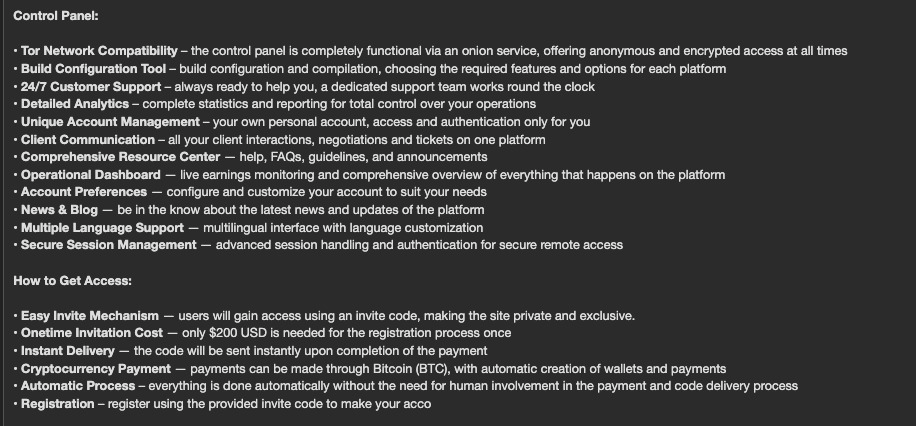
The US$200 invitation cost is low compared with the economic barrier associated with established RaaS programs, which may indicate an early-stage affiliate-acquisition strategy rather than a mature, vetted affiliate operation.
Observed Leak-Site Activity
The leak site lists ten visible victim cards, each providing a victim name, website, claimed data volume, business description, listing timestamp and a countdown or publication status. The visible listings represent approximately 279.7 GB of claimed data. The pattern is notable for its concentration on smaller and mid-market organizations and for repeated targeting of Indian businesses.
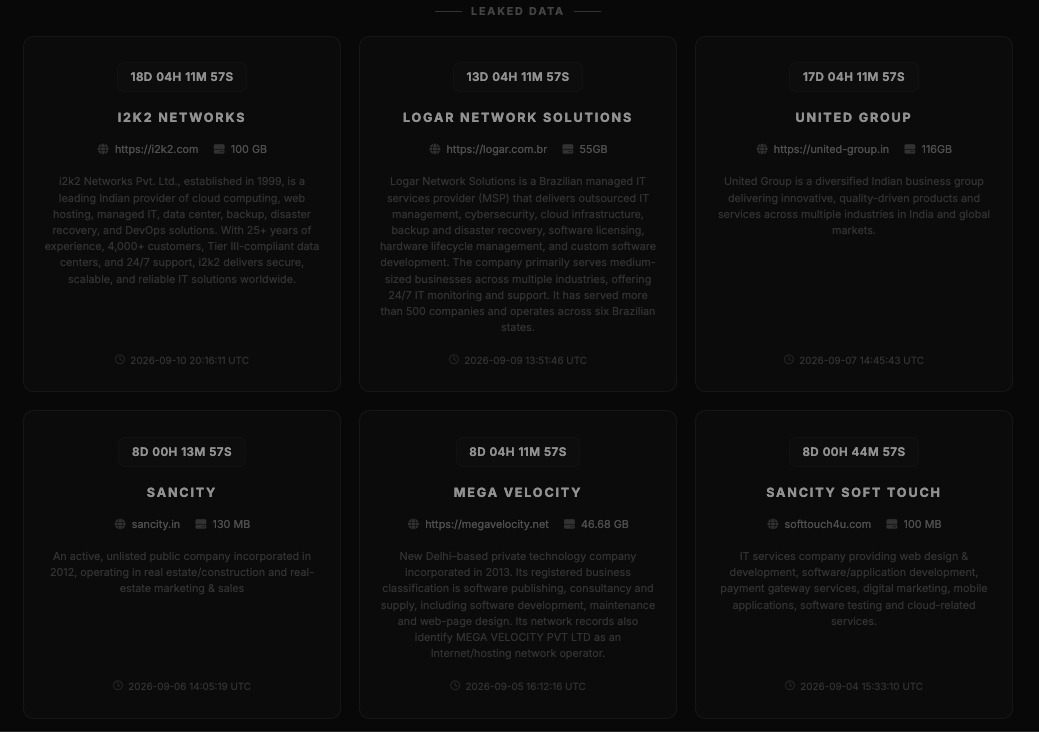
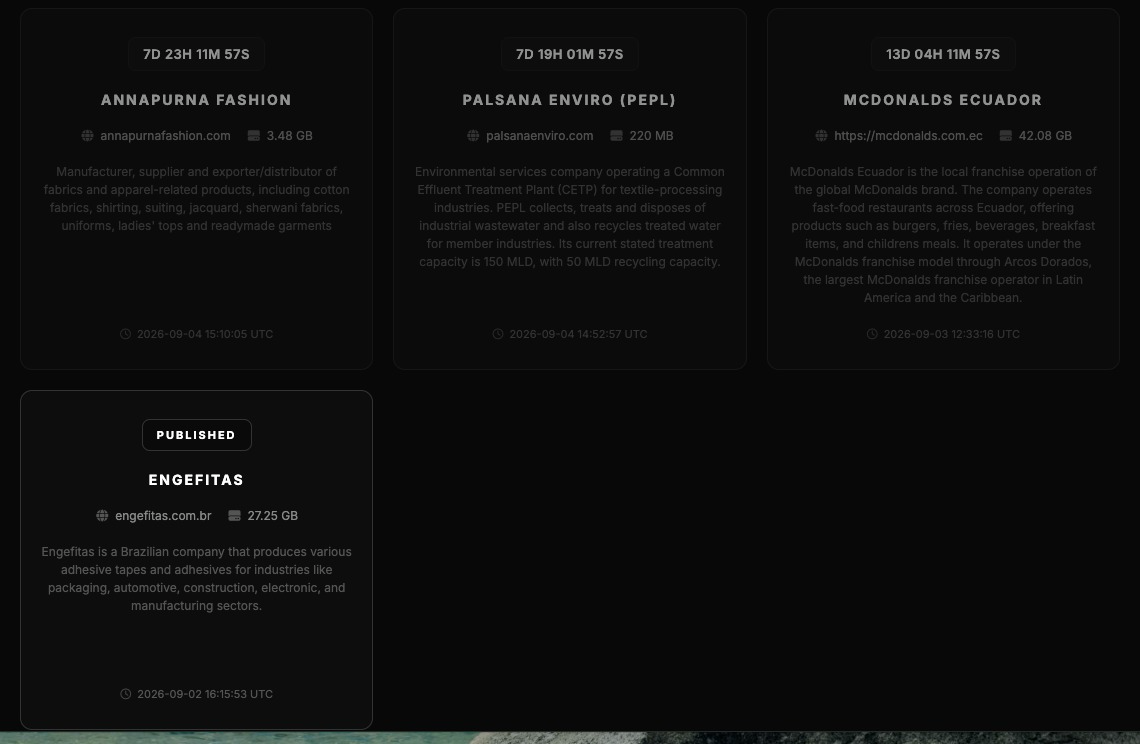
| Date | Claimed victim | Geography | Sector | Claimed volume | Site status |
|---|---|---|---|---|---|
| 2 Sep | Engefitas | Brazil | Manufacturing / adhesives | 27.25 GB | Published |
| 3 Sep | McDonald's Ecuador | Ecuador | Hospitality / franchise | 42.08 GB | Active countdown |
| 4 Sep | Palsana Enviro (PEPL) | India | Environmental / industrial wastewater | 220 MB | Active countdown |
| 4 Sep | Annapurna Fashion | India | Textiles / apparel | 3.48 GB | Active countdown |
| 4 Sep | Sancity Soft Touch | India-linked | IT services | 100 MB | Active countdown |
| 5 Sep | Mega Velocity | India-linked | Technology / hosting | 46.68 GB | Active countdown |
| 6 Sep | Sancity | India | Real estate / construction | 130 MB | Active countdown |
| 7 Sep | United Group | India | Diversified business group | 116 GB | Active countdown |
| 9 Sep | Logar Network Solutions | Brazil | Managed IT / MSP | 55 GB | Active countdown |
| 10 Sep | i2k2 Networks | India | Cloud / hosting / managed IT | 100 GB | Active countdown |
India Exposure: Why the Early Campaign Matters
India is the most visible geography in Vexy's early campaign. The claimed victims span environmental services, textiles, IT services, technology/hosting, real estate and diversified business operations — a breadth suggesting the actor may be selecting organizations based more on reachable attack surface and monetizable data than on a single vertical.
| Claimed victim | Business profile | Risk relevance |
|---|---|---|
| i2k2 Networks | Cloud, hosting, managed IT, data center, DR and DevOps | Potential concentration of downstream/customer data; high supply-chain relevance |
| United Group | Diversified Indian business group | Broad corporate data estate; sector diversity |
| Sancity | Real estate / construction | Financial, project, customer and contractual data |
| Mega Velocity | Software / consultancy / hosting per the supplied description | Potential privileged infrastructure and customer-data exposure |
| Sancity Soft Touch | IT services / application / payment gateway / cloud | Potential access to customer and application data |
| Annapurna Fashion | Textiles / apparel manufacturing and distribution | Operational and commercial IP |
| Palsana Enviro | Industrial wastewater / CETP | Industrial operations and environmental/compliance records |
What Remains Unproven
- Whether the advertised lockers have actually been deployed in the listed intrusions.
- Whether Vexy Group itself developed the encryptors or uses a third-party/leased codebase.
- The actual initial-access vector for any listed victim.
- Whether data was encrypted, exfiltrated, both, or in some cases only claimed.
- The authenticity and completeness of the claimed data volumes.
- The existence of a stable affiliate population rather than a single operator marketing an affiliate model.
MITRE ATT&CK Mapping — Advertised and Assessed Behaviours
Techniques marked "advertised" are derived from the underground post; they should not be represented as confirmed Vexy telemetry until samples or forensic reports are available.
| Technique | ATT&CK ID | Evidence status | Rationale |
|---|---|---|---|
| Data Encrypted for Impact | T1486 | Advertised | AES-256 encryption is explicitly claimed. |
| Inhibit System Recovery | T1490 | Advertised / implied | Free-space wiping and destructive recovery-related behaviour are advertised; VSS deletion is not in the primary forum post. |
| Service Stop | T1489 | Advertised | Windows/Linux service and process termination is explicitly advertised. |
| File and Directory Discovery | T1083 | Implied | Selective file/folder targeting is advertised, but discovery telemetry is unavailable. |
| Network Share Discovery / targeting | T1135 / related | Advertised capability | SMB/NFS network-share encryption is advertised. |
| Indicator Removal on Host | T1070 | Advertised | Self-deletion and event-log clearing are advertised. |
| Impair Defenses | T1562.001 | Possible | Service/process management may affect security tooling, but EDR tampering is not demonstrated. |
| Exfiltration Over Web Service | T1041 / related | Extortion model suggests | Leak-site publication implies data exfiltration may occur, but the transfer path is not documented. |
| Virtualization/Sandbox Evasion | N/A | Not established | No reliable evidence in the reviewed material. |
Initial Access: Evidence Versus Hypothesis
External analysis has proposed edge-appliance exploitation, RMM compromise, exposed RDP, credential abuse and phishing as plausible pathways. None of these is confirmed for any specific Vexy-claimed victim.
| Potential vector | Evidence level | Defensive priority |
|---|---|---|
| Stolen credentials / infostealer-derived access | Hypothesis; some tracker telemetry suggests relevance | High — monitor privileged and remote-access credentials |
| Internet-facing edge / VPN exploitation | Hypothesis | High — validate patching and exposure |
| RMM/MSP compromise | Hypothesis | High for IT-service-heavy victims |
| RDP / password spraying | Hypothesis | High — remove internet exposure and enforce MFA |
| Phishing / malicious documents | Generic ransomware vector; not Vexy-specific | Medium |
Defensive Detection Priorities
Organizations should focus on behaviours that precede or accompany ransomware deployment rather than waiting for a Vexy-specific hash.
- Monitor unusual authentication bursts against VPN, RDP and externally exposed services, especially involving privileged or service accounts.
- Alert on new remote-management software, unexpected RMM sessions and administrative connections outside approved maintenance windows.
- Detect abnormal remote process creation, newly installed services and administrative execution across multiple servers.
- Alert on sudden archive creation or large staging directories on file servers and application servers.
- Monitor destructive recovery activity and unexpected changes to backup infrastructure.
- Watch for security-control degradation, service termination and attempts to remove local traces.
- Monitor unusual outbound data transfers from file servers, databases and cloud-management hosts.
- Maintain rapid isolation capability for the first suspected staging host; do not wait for encryption to begin.
Recommended SIEM / EDR Hunt Themes
| Hunt theme | Example signal | Why it matters |
|---|---|---|
| Remote execution | WMI/remote service execution from unusual admin sources | Potential lateral movement before detonation |
| Archive staging | 7z/RAR/ZIP creation of unusually large archives on servers | Potential exfiltration preparation |
| Recovery tampering | Unexpected shadow-copy or backup-management changes | May precede destructive impact |
| Credential anomalies | Password spray, impossible travel, new privileged sessions | Possible stolen-credential access |
| RMM drift | New agent or session outside change window | Potential MSP/RMM entry path |
| Bulk egress | Large outbound transfer from sensitive servers | Potential double-extortion preparation |
Incident Response Priorities
- Preserve evidence from the suspected patient-zero system, identity provider, VPN/RMM infrastructure and file servers.
- Immediately rotate privileged credentials and invalidate active sessions if compromise is suspected.
- Isolate backup infrastructure and verify that immutable/offline copies remain inaccessible to compromised administrative identities.
- Block unnecessary east-west SMB/RDP/WMI paths while maintaining required business connectivity.
- Preserve the Vexy leak-site listing, timestamps, claimed volumes and screenshots as evidentiary artifacts; do not access or redistribute stolen data.
- Determine whether an incident involved data theft, encryption, both, or only an unsubstantiated claim.
- Engage legal/privacy teams early where regulated personal or customer information may have been accessed.
CyberMon Perspective: Why Vexy Matters
Vexy is a useful example of why Digital Risk Intelligence and Attack Surface Intelligence should be treated as complementary controls. The public evidence does not yet reveal a stable malware signature, but the operation's victim-selection and leak-site activity can be monitored externally.
| CyberMon capability | Vexy use case |
|---|---|
| Dark Web Intelligence | Monitor Vexy leak-site claims, emerging aliases, underground recruitment posts, victim mentions and data-publication events. |
| Attack Surface Intelligence | Identify internet-facing VPN, RMM, remote-access and administrative services that could become attractive entry points. |
| Credential exposure monitoring | Detect exposed corporate credentials and stealer-log references associated with monitored domains. |
| Brand / executive monitoring | Track references to organizations and leadership on emerging extortion channels. |
| Third-party risk intelligence | Monitor MSPs, hosting providers and technology partners whose compromise could create downstream exposure. |
CyberMon Confidence Assessment
| Claim / finding | Confidence | Reason |
|---|---|---|
| Vexy exists as an active extortion brand | High | Primary leak-site snapshot plus multiple independent trackers |
| Vexy advertises an affiliate/RaaS program | High | Direct underground forum advertisement |
| US$200 affiliate invitation fee is advertised | High | Direct underground forum advertisement |
| Rust multi-platform lockers exist | Low–Moderate | Advertised by the actor; no independent sample analysis |
| AES-256/RSA implementation is used in real attacks | Low | Advertisement only |
| Victim organizations were actually compromised | Low–Moderate | Leak-site claims corroborated as listings, not as breaches |
| India is a meaningful early target geography | Moderate–High | Large share of the supplied victim snapshot; later trackers also identify multiple Indian claims |
| Specific initial-access vector | Low | No victim-level forensic evidence in the reviewed material |
| Established-group affiliation / rebrand | Low | No reliable attribution evidence |
Threat Outlook
Vexy's next stage of development will be defined less by the quality of its advertisement and more by whether it demonstrates repeatable operational capability. The most important indicators to watch are sustained victim cadence, verified publication of samples, emergence of a stable affiliate community, reusable malware artefacts, confirmed initial-access patterns, infrastructure reuse, and movement into larger or more sensitive sectors.
- Near term: expect additional leak-site claims as Vexy attempts to establish credibility with affiliates and victims.
- Medium term: a genuine RaaS model should produce recurring victimology patterns and potentially multiple affiliate-specific operational signatures.
- Escalation indicator: appearance of validated samples, ransom notes, reusable infrastructure or confirmed compromise narratives would materially raise confidence in the group's technical maturity.
- India-specific concern: the early concentration of claims makes Indian mid-market organizations a sensible monitoring priority, particularly those with exposed remote access, RMM dependencies, hosting infrastructure or weak credential hygiene.
Conclusion
Vexy's claimed victim list should currently be treated as a serious but unverified set of cybercriminal claims. The concentration of Indian mid-market targets is a meaningful early signal regardless of how the technical capability claims eventually hold up, because victim-selection patterns tend to persist even as tooling evolves. The appropriate response is to monitor now, validate quickly if named, and avoid repeating attacker claims as confirmed facts.
For security teams, the broader lesson is the same one every emerging RaaS brand teaches: external threat monitoring and attack-surface visibility must operate together. Knowing that criminals are discussing or claiming your organization matters only if it is paired with reducing the externally exposed weaknesses — VPNs, RMM tooling, RDP, credentials — that let an advertised capability become a real intrusion.