Bank of Baroda Data Breach: What the TripleX Listing and Public Confirmation Reveal
Executive Summary
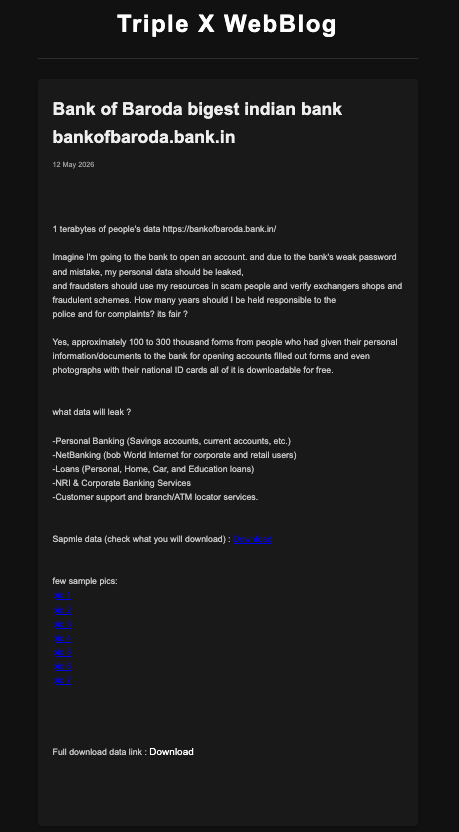
A data-leak site operating under the name Triple X published a post naming Bank of Baroda and alleged that approximately one terabyte of data had been obtained. The listing described customer and operational information whose names reference audits, regional and zonal operations, digital-banking functions, loan activities, customer-document workflows, technology, security, and other internal business processes.
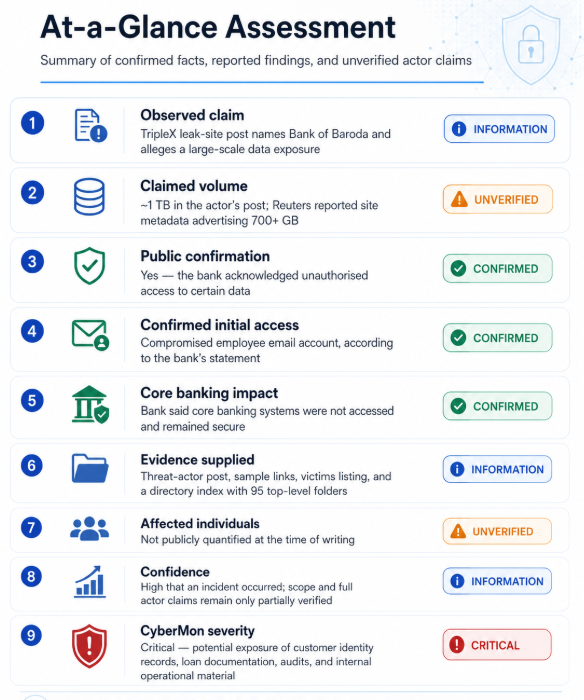
Unlike many underground claims that remain entirely unverified, Bank of Baroda subsequently acknowledged a security incident. In a statement reported by Reuters on July 27, 2026, the bank said that a compromised employee email account resulted in unauthorised access to certain data. The bank stated that its core banking systems were not accessed and remained secure, that initial containment measures had been implemented, and that a forensic investigation was underway with relevant authorities.
The bank's confirmation establishes that an incident occurred and provides a high-level initial-access explanation. It does not, however, validate every element of the threat actor's claim. The claimed one-terabyte volume, the completeness and authenticity of every listed folder, the number of affected customers, the duration of access, and whether all material originated directly from Bank of Baroda systems remain subject to forensic verification.
At-a-Glance Assessment
What the Triple X Post Claims
The threat actor alleges possession of people's data associated with the bank and lists broad categories including personal banking, net banking, loans, NRI and corporate banking, and customer-support and branch/ATM-related services.
Analysis of the Exposed Directory Index
The supplied HTML index contains 95 top-level directories. Folder names alone cannot prove the authenticity, ownership, completeness, or sensitivity of every underlying file. They nevertheless provide useful contextual indicators because many names appear consistent with banking operations, audits, regional workflows, digital-banking programmes, customer-document handling, loan processing, and internal technology administration.
What Bank of Baroda Has Officially Confirmed
According to Reuters, Bank of Baroda stated on July 27, 2026 that a compromised employee email account resulted in "unauthorised access to certain data." The bank said its core banking systems were not accessed and continued to remain secure. It also said that initial containment measures had been implemented, a forensic investigation had begun, and it was working with relevant authorities.
Confirmed and Unconfirmed Elements
| Element | Status | Basis |
|---|---|---|
| A security incident occurred | Confirmed | Bank statement reported by Reuters |
| Employee email account was compromised | Confirmed | Bank statement |
| Unauthorised access to certain data | Confirmed | Bank statement |
| Core banking systems were accessed | Denied by bank | Bank says core banking systems were not accessed |
| Initial containment and forensic review | Confirmed | Bank statement |
| Exact number of affected customers | Unknown | Not publicly disclosed |
| Detailed intrusion chain beyond email compromise | Unknown | No official confirmation |
About TripleX
TripleX is an emerging threat actor observed on data-leak platforms in June 2026, with an apparent focus on large-scale data theft and public disclosure targeting financial institutions, government organisations, and large enterprises. Its modus operandi focuses on stolen-data monetisation, extortion, reputational pressure, or resale rather than the encryption-led model associated with traditional ransomware operations.
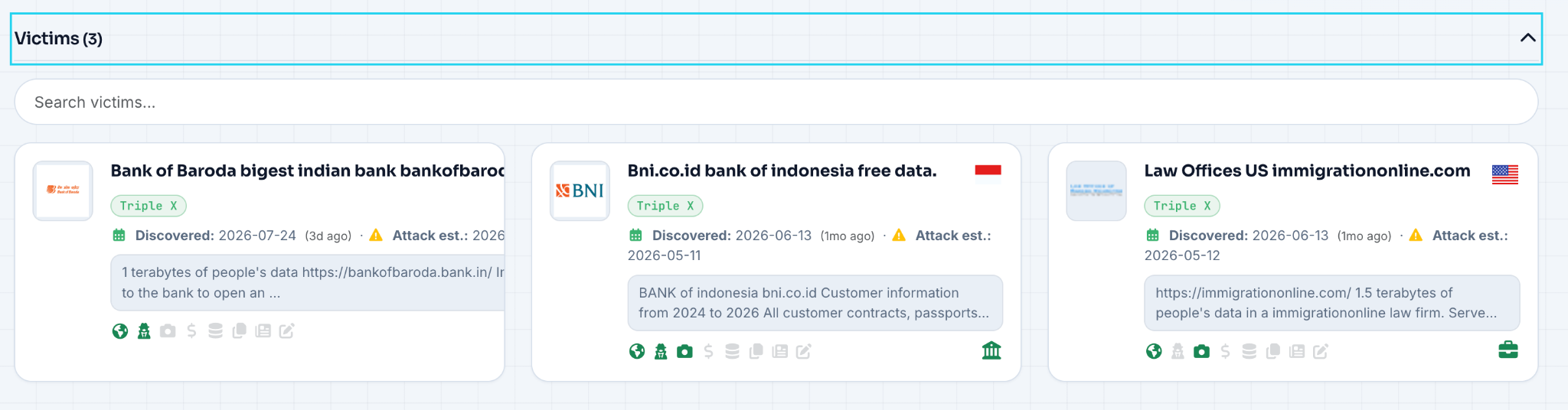
The Data Leaks Site (DLS) associated with TripleX shows only three victims so far: Bank of Baroda, Indonesia's BNI, and a United States immigration-law firm. This is consistent with the group's motivation for financial gain.
Potential Exposure and Risk
The leaked material included customer details, identification documents, loan papers, and internal audit records. Potential exposure risks include:
- Identity theft and synthetic-identity fraud using names, identity documents, addresses, or onboarding records.
- Targeted phishing, voice phishing, and customer-support impersonation using bank-, branch-, product-, or loan-specific context.
- Loan and financial-document abuse, including fraudulent applications, social engineering, and manipulation of customer or guarantor information.
- Operational intelligence exposure through audit, inspection, technology, branch, process, and internal programme documentation.
- Third-party risk if information contains documents involving insurers, vendors, borrowers, partners, or other counterparties.
- Long-term fraud risk because identity and historical banking documents cannot be rotated as easily as passwords.
Recommended Response Priorities
For Bank of Baroda and Investigating Authorities
- Determine the complete mailbox-compromise timeline, including initial authentication, suspicious sessions, forwarding rules, OAuth grants, token activity, mailbox searches, downloads, and access from unusual devices or networks.
- Establish whether the compromised account had direct access to shared drives, collaboration platforms, document repositories, customer-workflow systems, or links that permitted access outside the mailbox.
- Validate every published folder and sample against authoritative systems, using hashes, metadata, ownership records, and access logs.
- Identify affected individuals and counterparties, classify exposed data, and issue risk-based notifications in accordance with applicable regulatory requirements.
- Reset credentials, revoke active sessions and tokens, review privileged access, and strengthen phishing-resistant multi-factor authentication for high-risk identities.
- Monitor the actor's site and secondary forums for new samples, mirrors, repackaging, sale attempts, or references to credentials and internal systems.
For Customers
- Treat unexpected calls, messages, emails, and links referring to Bank of Baroda accounts, loans, KYC, refunds, account blocking, or document verification with heightened caution.
- Use only official bank applications, websites, phone numbers, and branch channels; do not share OTPs, PINs, passwords, CVVs, or remote-access permissions.
- Review account statements and alerts for unauthorised transactions, beneficiary additions, profile changes, or unusual login activity.
- Change reused passwords immediately and enable the strongest available multi-factor authentication.
- Preserve suspicious messages and report fraud attempts promptly to the bank and appropriate cybercrime channels.
Conclusion
The Bank of Baroda case should no longer be described solely as an unverified dark-web allegation. The bank has confirmed a security incident involving a compromised employee email account and unauthorised access to certain data, while stating that its core banking systems were not accessed. The exact scope of the exposure remains under investigation.