The Agentic SOC: What Security Leaders Need to Get Right
Somewhere right now, an attacker is inside a network they were never invited into. In 2025, the average time between that first foothold and the moment they start moving sideways, hunting for something valuable, dropped to 29 minutes. The fastest recorded case took 27 seconds. Not minutes. Seconds.
No SOC built around people reading alerts one at a time can keep pace with that. This is the plain fact sitting behind every conversation happening in security right now about artificial intelligence, and it's why boards that used to treat AI security as a line in the annual budget review are asking sharper questions this year.
What follows is an attempt to answer those questions honestly: what's actually working, what's still mostly marketing, and what a CXO needs to do, roughly in order, to get real value out of AI in the SOC without quietly creating a new problem in its place.
Two stories, and only one of them is true everywhere
Ask a vendor about AI in the SOC and you'll hear one story: agents that triage alerts, draft incident reports, and hunt threats around the clock without waiting on a tired analyst at 2 a.m. Gartner has a name for where that story currently sits on its hype curve, the Peak of Inflated Expectations, the stage where visibility is highest and the gap between promise and proof is widest. Real deployment, by Gartner's own estimate, still sits at just 1-5% of organizations.
Ask a working CISO instead and you get a second, quieter story. Splunk surveyed 650 of them in mid-2025 and found genuine enthusiasm wherever AI is actually running: 92 percent say it lets them review far more security events than before, and teams running agentic AI in production report detection and response speeds more than twice as fast as teams still just experimenting.
But ask those same CISOs a harder question, do you actually know what your AI agents are doing, and the story shifts again. Okta's 2026 survey of 306 security leaders found that fewer than half can say, with real confidence, that they know every AI agent running in their environment, control what those agents can access, or approve the individual actions those agents take.
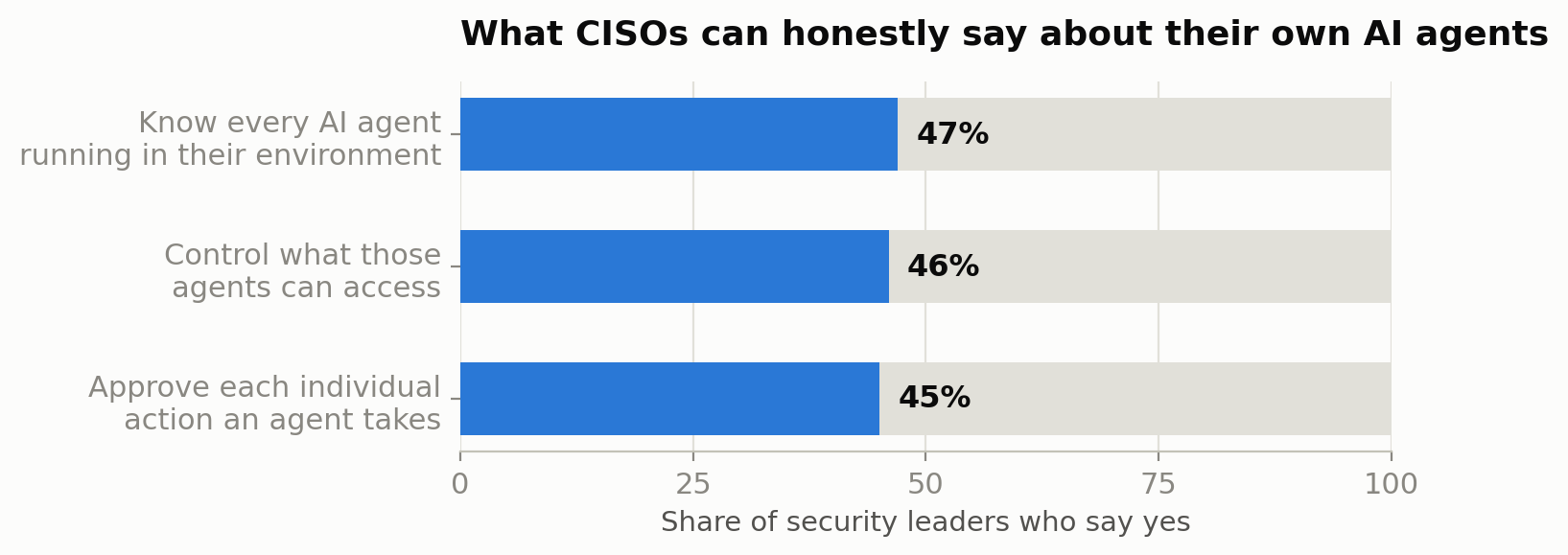
An AI agent with access to your tools isn't a feature. It's an identity, with permissions and a blast radius, and most organizations still aren't treating it like one. Gartner's advice to buyers is blunt: if a vendor can't show you exactly how a decision was made and controlled, don't call it an autonomous agent. Call it what it is, an unverified workflow, and budget accordingly.
Where does your own SOC actually sit?
Most conversations about AI maturity happen in the abstract. It helps to make it concrete. Security teams tend to move through five recognizable stages, and most mid-market organizations today sit somewhere between the second and the third.
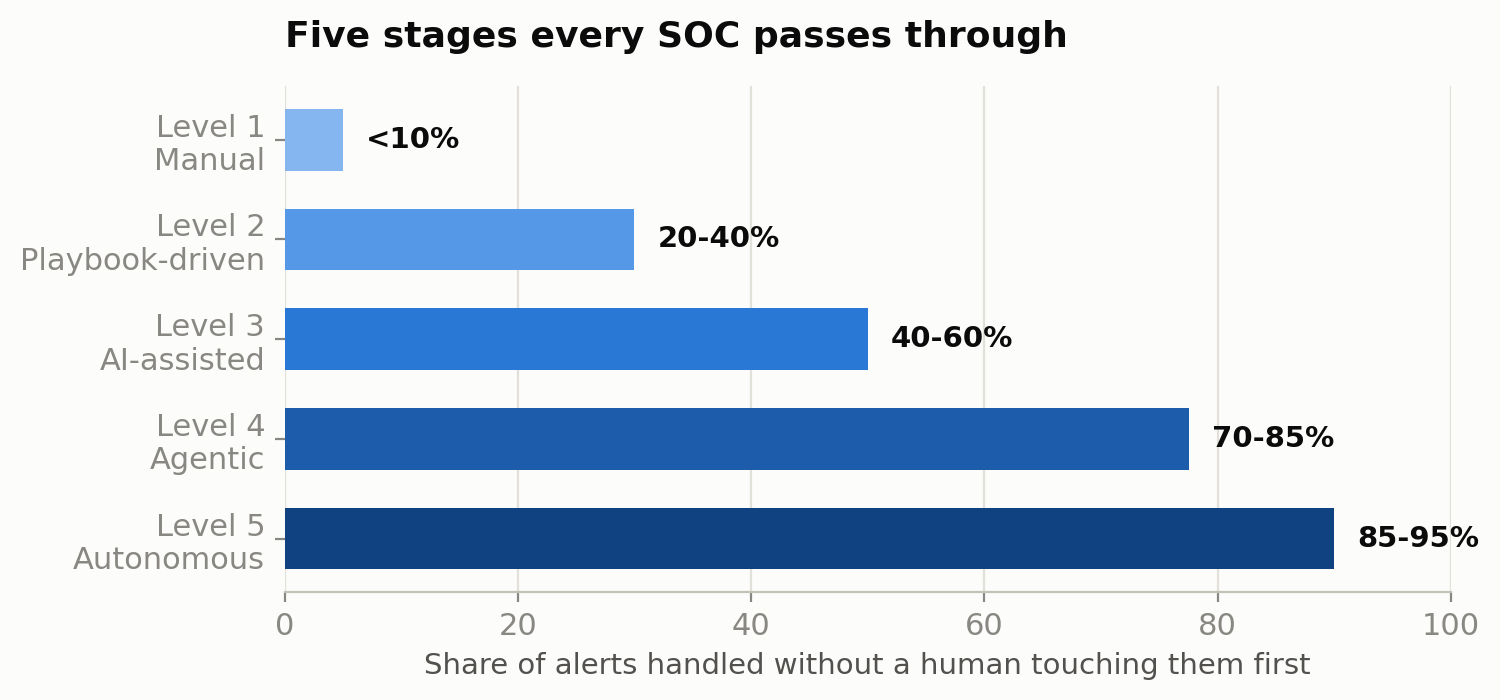
At Level 1, a person reads every alert and decides what to do by hand, and it isn't unusual for a real threat to sit undetected for more than a day. By Level 3, a copilot suggests the next step and an analyst approves it, which removes a lot of the busywork but still keeps someone in every loop. It's only from Level 4 onward that agents start acting on their own for the low-risk, high-volume work, saving human judgment for the calls that actually need it.
One modeled case, a mid-market deployment covering 1,000 endpoints and a five-person team, put a number on what that shift is worth: alert triage time falling from roughly 45 minutes to under two, false positives dropping from the 60 to 80 percent range to under 10 percent, and a modeled net return of 539 percent once implementation costs were subtracted. Numbers like that deserve a healthy dose of skepticism, they come from a vendor case study, not an audited outcome, but even a fraction of that return, delivered safely, changes the economics of running a SOC.
How long does this actually take? It depends almost entirely on how many tools you already run and how many people need to sign off, not on which vendor you pick. A pattern that holds fairly consistently: organizations with one or two SIEM or EDR tools and a short chain of decision-makers can get through scoping, integration, a shadow-mode pilot, and production cutover in two to four weeks. Mid-sized organizations juggling three to five tools and formal compliance mapping tend to need four to six. Large, multi-region enterprises running more than one SIEM, with change management across shift patterns and several regulatory jurisdictions, are realistically looking at six to ten weeks for a focused rollout.
| Org size | Total time | Scoping | Integration | Shadow pilot | Cutover |
|---|---|---|---|---|---|
| SMB (under 500 people) | 2-4 weeks | 2-3 days | 1-1.5 weeks | 3-5 days | 1-2 days |
| Mid-market (500-5,000) | 4-6 weeks | 1 week | 2-3 weeks | 1-2 weeks | 2-3 days |
| Enterprise (5,000+) | 6-10 weeks | 1-2 weeks | 3-4 weeks | 2-3 weeks | 1 week |
Six things worth getting right, roughly in this order
1. Treat every agent like a new hire with admin rights
Because that's effectively what it is. Before scaling anything, map your program against NIST's AI Risk Management Framework: govern, decide who owns this at the top; map, find where AI actually touches your infrastructure and data; measure, work out how likely and how bad the failure modes are; and manage, put technical and procedural controls in place that catch problems when they happen. Then put AI risk on the board's agenda directly, in plain business terms. Right now only 46 percent of CISOs believe their board even sees AI security as something that helps the business, rather than a compliance cost to tolerate.
There's a practical reason to take this seriously beyond risk reduction. Five controls do most of the work: human sign-off on any critical action, a full audit trail of every step the AI takes, reasoning an analyst can actually follow rather than a black-box verdict, role-based access over who can configure or override the AI, and regular testing against simulated attacks. Those same five controls map almost directly onto the access, monitoring, and testing requirements already sitting inside SOC 2, ISO 27001, HIPAA, and NIS2. Build them once, properly, and you get a safer AI SOC and audit-ready evidence for frameworks you're already on the hook for.
2. Fix your data before you fix your process
An agent is only as good as what it can see. Before any serious rollout, consolidate your logging, enrich it with real asset context (what actually matters if it's compromised), and feed it current threat intelligence. Just as important, write down what your best analysts already carry in their heads, the shortcuts, the judgment calls, the "this alert always turns out to be nothing" instincts, so the agent inherits that expertise instead of reinventing it badly.
3. Redesign roles, don't just remove tasks
The honest version of "AI replaces Tier 1" is that Tier 1 work changes shape. Analysts freed from repetitive triage move into more senior work: refining detection logic, hunting threats, reviewing what the agents actually did. That's a good outcome, but only if it's planned and budgeted for. Two-thirds of security teams already report significant burnout; a role transition nobody prepared them for will make that worse, not better.
4. Spend real money securing the AI, not just buying more of it
Here's an uncomfortable number.
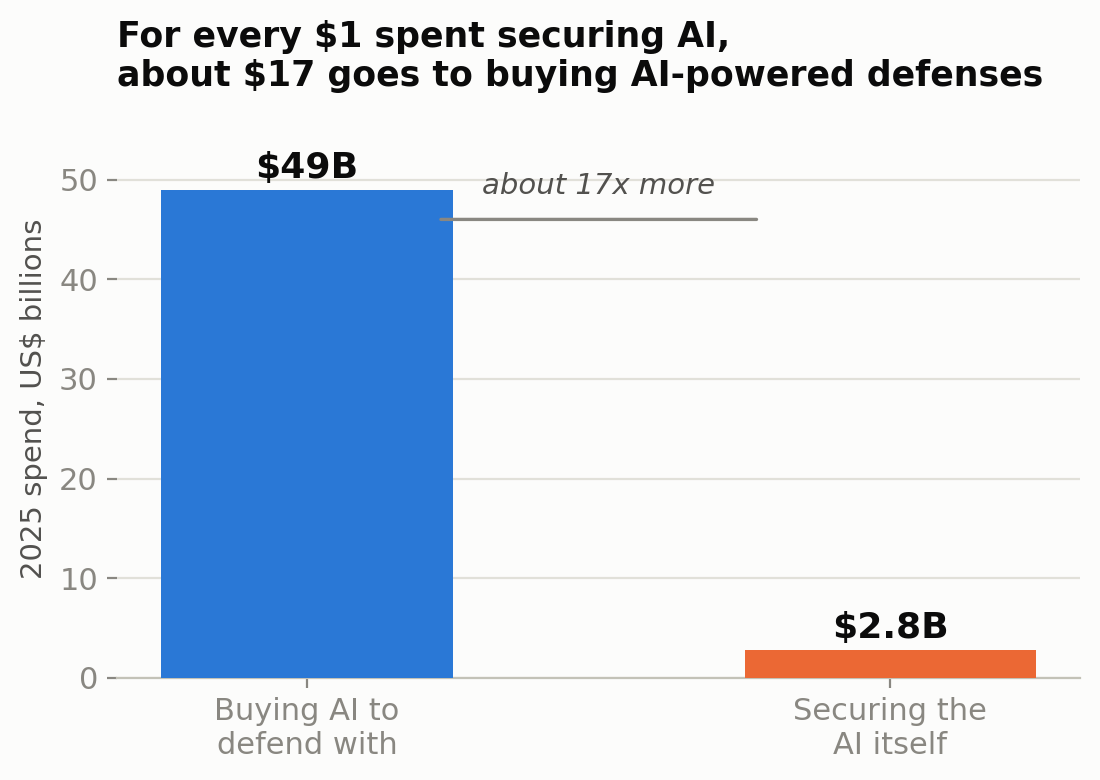
For every dollar organizations spend securing their AI systems, they're spending roughly seventeen dollars buying AI to defend with. That imbalance is exactly where the next serious incident is likely to start. Agentic tools that can take action on your behalf are also unusually easy to manipulate: testing has found prompt injection succeeding against tool-using agents up to 84 percent of the time, far higher than against a simple chat interface. One successful injection can chain into stolen data, unauthorized commands, and lateral movement in a single sequence. The fix isn't exotic. Validate what goes into the model, make sure system instructions can't be overridden by whatever text the agent happens to ingest, grant the narrowest possible tool access with a human sign-off on anything sensitive, check what comes out for signs of leakage, and test the whole thing against known attack patterns on a regular schedule.
5. Match the guardrails to how much autonomy you're granting
The more independently an agent acts, the more you need to be able to reconstruct, after the fact, exactly why it did what it did. That means a bounded scope for what an agent can touch, version control on its logic and prompts, clear ownership of who can adjust its thresholds or approve its actions, and a cost cap so a runaway process doesn't become a runaway bill. Build this before scaling, not after something goes wrong.
It helps to think of autonomy as a dial with three settings, not a switch.
- Tier one is fully supervised, nothing happens without a human approving it first.
- Tier two is constrained autonomy, the agent can act on its own but only within a narrow, pre-approved set of action types.
- Tier three is broad autonomy, the agent acts freely within defined boundaries under continuous monitoring, with humans reviewing rather than approving each step.
Most organizations don't fail by picking the wrong tier. They fail by skipping the dial altogether and defaulting new agents straight to broad autonomy because that's the tier the demo was set to. Grant the lowest tier that actually gets the job done, and move an agent up a tier deliberately, never by default. Independent research on enterprise agent deployments suggests a large share of organizations, by some estimates as many as 4 in 5, don't have full visibility into every agent running in their environment, and that roughly half of enterprise AI usage happens through personal accounts that never touch single sign-on. Those two numbers alone explain most agent-related incidents. You can't govern what you can't see, which is why an inventory comes before any of the rest of this.
6. Report progress in numbers your board will actually believe
CISO liability concern is up sharply this year: more than three-quarters now say they personally worry about it, and nearly all of them carry some formal AI governance responsibility whether they asked for it or not. A short, consistent set of metrics goes a long way: detection and response time trends, alert triage time, false-positive rate, the share of actions taken autonomously versus with a human sign-off, and how current the agent-access reviews actually are. The same numbers, reported the same way every quarter, are what turn board skepticism into sustained budget.
A readiness check before you call anyone
Before the first vendor call, it's worth scoring your own organization honestly against ten questions. This isn't a sales qualification exercise, it's an operational planning tool, and being honest about the gaps now saves months later.
- A documented inventory exists of every security tool and data source you run, not a mental list someone in IT could probably reconstruct.
- Current MTTD and MTTR are measured, not estimated from memory.
- An executive sponsor is identified and genuinely committed, not just named on a slide.
- A technical lead has five to ten hours a week free during onboarding.
- Your existing tools support API-based integration.
- You've mapped which compliance frameworks actually apply to you (SOC 2, ISO 27001, HIPAA, NIS2, or others specific to your industry).
- An analyst champion is designated to own change management on the floor, not just the rollout on paper.
- Incident response playbooks are actually written down, not just known by your most experienced person.
- Budget is approved, not informally discussed.
- API access and credentials are ready for the systems that need to connect.
Score one point for every yes. Eight to ten and you're ready to start evaluating vendors now. Five to seven and you need one to two weeks of prep work, mostly documentation you already have somewhere, it just needs pulling together. Below five, fix the gaps first. An executive sponsor and a real tool inventory matter more at this stage than which vendor you eventually choose. Even the best AI SOC deployment stalls in week one without them.
What could still go wrong
Even a well-governed rollout doesn't erase every risk. A few are worth watching specifically because they're new, or newly serious, in 2026.
- Non-human identities are quietly becoming the weak link: only about 1 in 6.7 organizations feel confident securing their AI and service identities, against 1 in 4 for human ones, and gaps in credential rotation are the most cited cause of related incidents.
- CISOs now rank AI-generated phishing, rogue or manipulated agents, and deepfake-enabled authentication bypass among their top concerns (61, 49, and 45 percent respectively).
- The EchoLeak vulnerability in Microsoft Copilot (CVE-2025-32711) showed that a well-crafted piece of ingested content, with no click required from the victim, could quietly exfiltrate data through a legitimate AI assistant. Any SOC copilot that reads tickets, emails, or third-party threat feeds carries some version of that same exposure.
- 68 percent of CISOs admit unsanctioned AI tools are already running somewhere in their organization, usually well ahead of any policy written to govern them.
- The same prompt-injection techniques that compromised developer tooling inside CI/CD pipelines apply just as well to a SOC toolchain built on external AI agents.
One more date worth knowing if you operate in or serve the EU. The AI Act's Article 12 requires high-risk AI systems to automatically log events across their lifetime, and Article 26 requires deployers to keep those logs for at least six months. Penalties for non-compliance reach fifteen million euros or three percent of global turnover, whichever is larger. Build tamper-evident logging into your AI SOC controls now and this becomes a non-issue later. Bolt it on after an audit finding and it becomes a far more expensive project.
Who's actually building this
The vendor market hasn't settled yet, and it's moving fast enough that any list goes stale within months. Broadly, it splits two ways: established platforms bolting agentic features onto tools you may already own, and newer companies built agentic from day one.
| Platform | What it is |
|---|---|
| Microsoft Security Copilot | A GPT-based assistant tied closely to the Microsoft security stack. Mostly prompt-driven today, not fully autonomous. |
| CrowdStrike Charlotte AI / Falcon | Agentic features layered on top of Falcon's endpoint telemetry, expanding into agent orchestration under the Charlotte name. |
| Palo Alto Networks Cortex XSIAM | A combined detection, response, and SIEM platform. Powerful, but a heavy lift to implement well. |
| Splunk SOAR | Mature, broadly integrated playbook automation. Still needs sustained engineering time to maintain. |
| Dropzone AI, Prophet Security, Conifers.ai, Intezer, Torq | Newer companies built agentic from the start. Some deploy in days with little configuration; others go deep on forensic investigation. |
Judge any platform the way Gartner suggests, by whether it can show you how a decision was made, not by whether its marketing uses the word "autonomous."
How to actually evaluate a vendor
Most vendor evaluations go wrong the same way. Buyers get pulled in by AI capability marketing, the most advanced model, the most autonomous agents, the biggest training set, while skipping the operational questions that actually determine whether the deployment works six months in. A more reliable approach is to score each finalist, zero to two, on seven plain questions.
- Does it work with what you already run, or does it quietly require replacing your SIEM or EDR before it delivers any value?
- How fast can it actually go live? Thirty days is achievable for a focused deployment. If the answer is a multi-month professional services engagement, ask why.
- When the AI can't resolve something, who do you actually reach? A ticket queue with a multi-hour response time is a very different product from direct access to a senior analyst.
- Can it contain a threat, or only describe one? Detection and notification are the easy part; ask exactly what it can do without a human clicking anything, and what it escalates instead.
- Can it verify a suspicious action with the person it actually affects, not just log it? A 2 a.m. login from an unfamiliar location is far more useful triaged when the system can message the affected employee directly and get a yes or no.
- Is pricing public and predictable, or hidden behind a quote that changes after year one?
- Is compliance evidence generation built in, or a separate line item you'll need to buy again?
A vendor scoring twelve or higher out of fourteen is worth a serious evaluation. Below eight, you're likely buying an alert feed with an AI label on it, not a system that changes how your SOC actually operates.
A story in three steps: the next 90 days
None of this has to start big. A sensible first 90 days looks something like this.
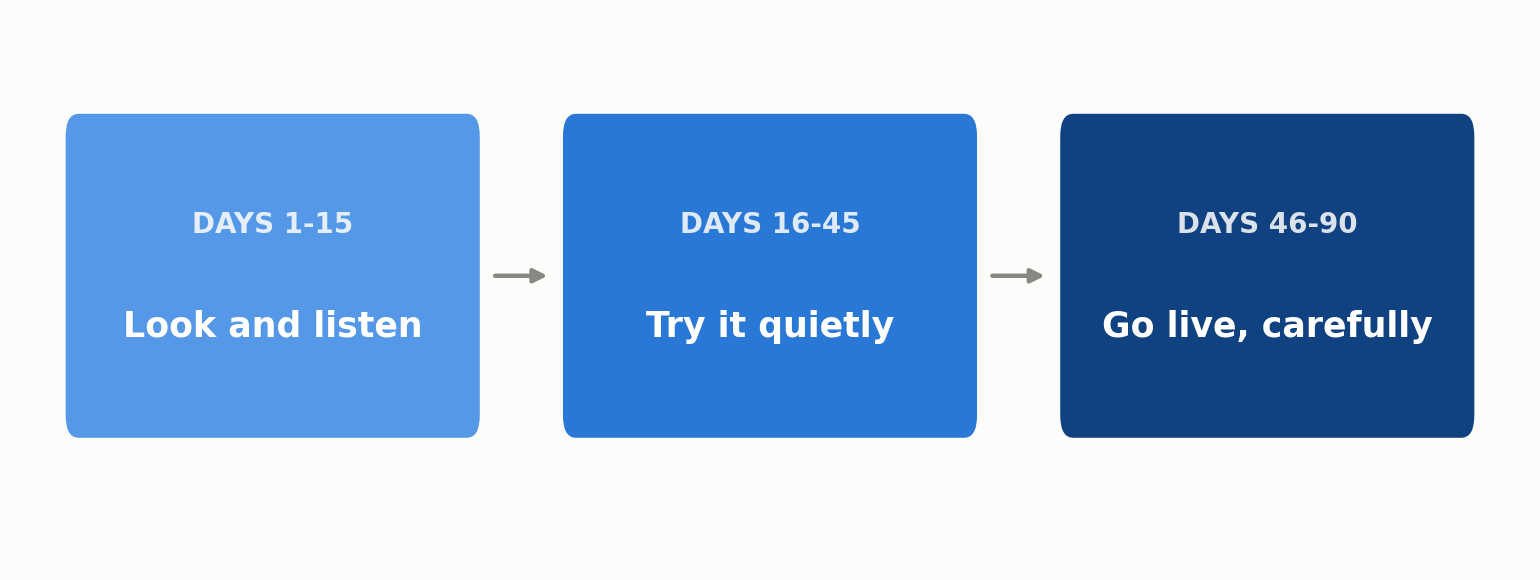
In the first two weeks, the job is mostly listening: find every AI agent already running, sanctioned or not, write down your current numbers (detection time, response time, alert volume, how burned out the team already is), and get the board into one room to agree, explicitly, on how much AI risk the organization is willing to carry.
Over the following month, pick one narrow, high-volume problem, phishing triage is the most common starting point, and run an agent alongside your analysts without letting it act on its own yet. Use that window to build the governance structure it will eventually operate inside: NIST-mapped approval gates, action logging, all of it.
By day 90, move that pilot into production, but only let it act independently on the lower-risk calls. Start writing your best analysts' judgment into its operating context, and put together the first version of the metrics package for the board. None of this finishes at day 90. It just means you've started somewhere real instead of somewhere borrowed from a vendor slide.
Where this leaves you
The technology here is genuinely useful, in the places it has actually been proven. The problem was never the technology. It's that fewer than half of security leaders can currently say, honestly, that they know what their own AI agents are doing. Fix that first, and everything else in this blog becomes a lot more straightforward. Skip it, and 2026 may be remembered as the year a lot of organizations handed real operational authority to systems nobody had fully checked.