Accenture Breach Claim on an Underground Forum: Why Source Code and Cloud Secrets Are a Supply-Chain Risk
Executive Summary
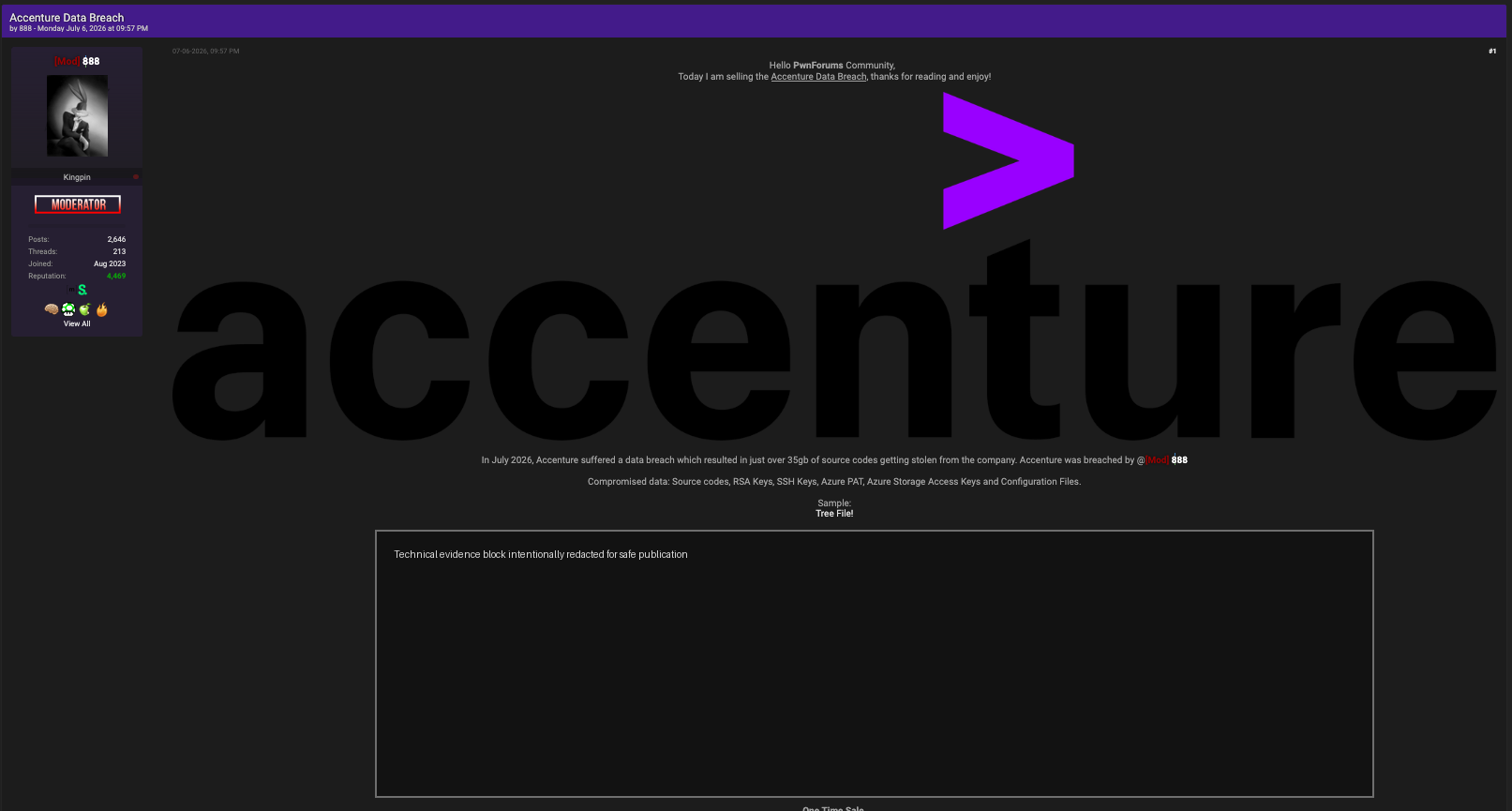
On July 6, 2026, a threat actor using the handle "888" posted on an underground forum claiming to sell data allegedly linked to Accenture. The listing claims that more than 35 GB of source code and sensitive technical material were stolen, including RSA keys, SSH keys, Azure Personal Access Tokens, Azure Storage access keys, and configuration files.
The forum sale post has a technical evidence section referencing Azure DevOps repository metadata and a git clone operation. The file tree shared in the post is a very large directory inventory with more than 6 million lines, mapping multiple web platforms, backend services, staging environments, dependency folders, and supporting utilities. Public reporting by BleepingComputer states that Accenture confirmed a security breach, described the matter as isolated, and said it had remediated the source with no impact to operations or service delivery.
For security leaders, the importance of this incident is not limited to Accenture alone. It is a practical example of how source code repositories, DevOps credentials, cloud access keys, and third-party development environments can become high-impact digital risk exposure points. Even when a vendor says operations are unaffected, customers should still evaluate whether their code, integrations, credentials, or project environments could be indirectly exposed.
At-a-Glance Assessment
| Observed claim | Sale post alleging an Accenture data breach and theft of source code and secrets |
|---|---|
| Actor handle | 888 / [Mod] 888 |
| Claimed volume | More than 35 GB, according to the actor and public reporting |
| Claimed data types | Source code, RSA keys, SSH keys, Azure PATs, Azure Storage keys, configuration files |
| Evidence shown | Azure DevOps-style repository metadata and git clone output, redacted for safe publication |
| Additional artifact | A claimed directory-tree inventory with more than 6 million lines |
| Confidence | Medium to High that the post and claim are real; scope remains unverified |
| Severity | Critical, because source code and cloud secrets can enable downstream compromise |
What the Underground Forum Screenshot Shows
The screenshot shows a forum page titled "Accenture Data Breach." The post appears to be authored by the handle "888," marked with a moderator badge in the forum profile panel. The content states that the actor is selling an "Accenture Data Breach" dataset and claims the data includes source code and multiple forms of cloud and authentication secrets.
![Forum profile panel for user 888, showing a [Mod] tag, an avatar image, the title 'Kingpin', a red MODERATOR badge, and stats: 2,646 posts, 213 threads, joined August 2023, reputation 4,469.](/static/media/forum-profile-panel.b89adf7c595bd9c33d57.png)
Technical Evidence Shown in the Alleged Accenture Data Breach Claim
The screenshot shared by the threat actor appears to show command-line activity involving an Azure DevOps repository allegedly connected to Accenture. The visible terminal output includes an API request to Azure DevOps followed by a git clone operation, suggesting that the actor is attempting to demonstrate access to a private source code repository.
The first visible command appears to use curl to query the Azure DevOps Git repositories API. The API response shows repository metadata for a project named '121123_AtriasTalentAcademy' under an Azure DevOps organization or project path labelled LISTeamRepos. The returned metadata includes details such as repository ID, project ID, repository URL, default branch, repository size, and web/SSH clone URLs.
curl -u [REDACTED] "https://LISTeamRepos@dev.azure.com/LISTeamRepos/121123_AtriasTalentAcademy/_apis/git/repositories?api-version=7.1"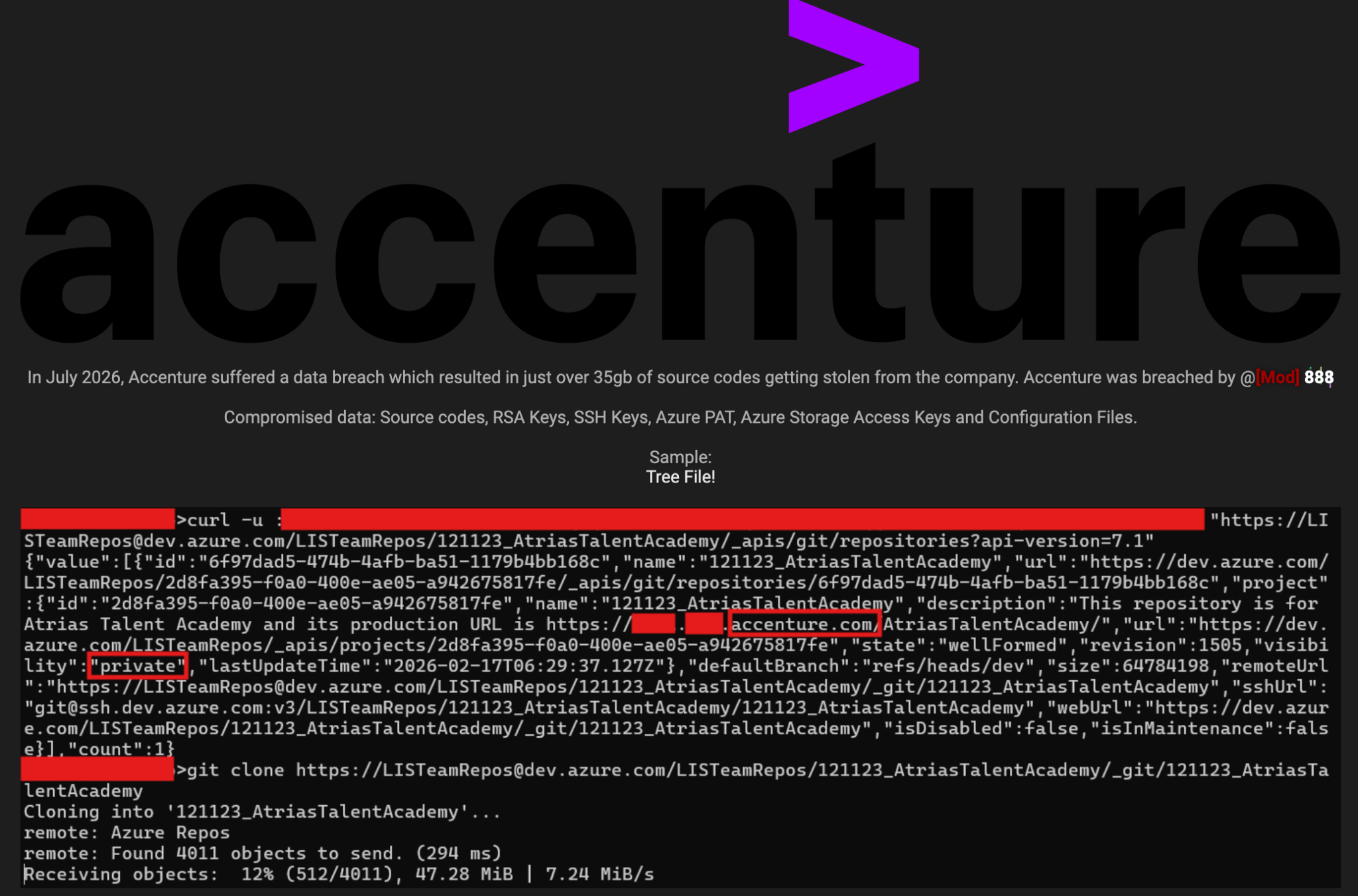
One of the most important visible indicators is that the repository visibility is marked as private. This is significant because private repository metadata is not normally accessible without valid authentication or authorization. The API output also references a production URL on an accenture.com subdomain, although part of the URL is redacted in the screenshot.
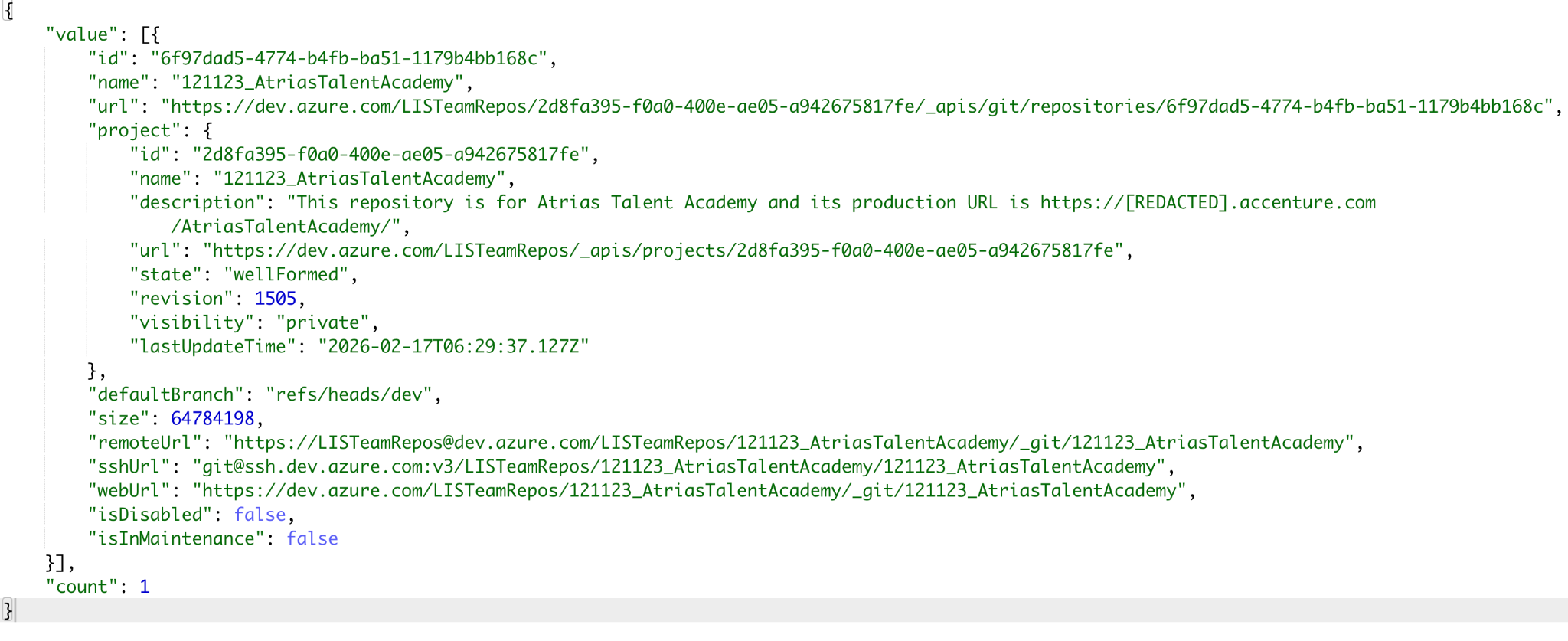
The second visible command shows a git clone operation against the same Azure DevOps repository. The terminal output indicates that the repository clone process had started successfully, with Azure Repos responding and preparing thousands of objects for transfer.
git clone https://LISTeamRepos@dev.azure.com/LISTeamRepos/121123_AtriasTalentAcademy/_git/121123_AtriasTalentAcademy
This type of output is usually shown when a Git client has successfully authenticated and started downloading repository contents. While the screenshot alone does not prove the full scope of the alleged breach, it does provide technical-looking evidence that the actor may have had access to at least one private Azure DevOps repository.
From a security perspective, this is a critical indicator because source code repositories can contain far more than application code. They may include configuration files, deployment scripts, API endpoints, internal architecture details, environment references, hardcoded secrets, access tokens, certificates, SSH keys, cloud storage references, and third-party integration details. Even when secrets are not directly exposed, repository contents can help an attacker understand how an enterprise application ecosystem is structured.
The repository name and description suggest that the affected project may be related to a talent academy or learning platform. If accurate, this could point to an internal or partner-facing application used for learning, training, employee enablement, certification, or digital academy operations.
Directory-Tree Inventory
Along with the underground forum screenshot, the actor shared a file tree named '251MQ.txt'. It is a very large directory-tree inventory containing more than 6 million lines.
At a high level, the file summary indicates a broad Accenture application ecosystem made up of related web platforms, backend services, staging environments, production variants, and supporting utilities. The inventory is said to begin with ABCtalent_Staging and expand into projects such as academy portals, learning platforms, project trackers, calendar tools, service desk applications, security learning portals, DevOps systems, Salesforce and SAP-related applications, and multiple Node.js backend services.
Key Themes Identified in the Directory-Tree
- Learning and talent enablement appear central, with project names and assets pointing to talent academies, learning journeys, certifications, dashboards, FAQs, feedback flows, and role-based course content.
- The ecosystem appears to span multiple domains, including DevOps, Agile, cybersecurity, SAP, Salesforce, Oracle calendars, service desk operations, system integration, automation, and security learning.
- Staging and production variants appear repeatedly, suggesting that applications were deployed, tested, and maintained across different release stages.
- Backend services appear separated from frontend portals, with related Node.js services supporting data, uploads, analytics, feedback, and maintenance workflows.
- Static assets appear to play a major role, including images, banners, icons, CSV uploads, learning journey graphics, and branded visual assets, indicating a content-rich platform ecosystem.
Why This Matters Beyond One Vendor
Traditional breach conversations often focus on personally identifiable information, customer databases, or ransomware impact. This incident is different because the claim focuses on source code and DevOps secrets. These assets can be more dangerous than a static database dump because they may provide attackers with a map of internal logic, application dependencies, infrastructure patterns, hardcoded credentials, and integration paths.
1. Source Code Can Reveal How Systems Work
Source code exposure can help attackers identify hidden API endpoints, authentication logic, insecure functions, internal service names, dependency versions, and business workflows. Even if no production system is immediately compromised, exposed source code can shorten the attacker's research cycle and make later exploitation more targeted.
2. Cloud Secrets Can Turn a Leak Into Access
The listing claims Azure PATs, SSH keys, RSA keys, and Azure Storage access keys were included. These are not ordinary documents. If valid and unrotated, such secrets can provide access to repositories, build pipelines, storage accounts, or infrastructure-adjacent systems. The risk is especially high where tokens have broad privileges, long expiry windows, or insufficient conditional access controls.
3. Third-Party Delivery Environments Create Downstream Exposure
Large consulting and technology providers often build, host, integrate, or manage systems for customers. A compromise of a vendor development environment may therefore create indirect risk for clients, even if the client's own perimeter was never breached. Customers should evaluate whether their projects, repositories, integrations, service accounts, and credentials were ever present in the affected environment.
Signals Security Teams Should Watch
The breach claim highlights several practical signals that security teams should monitor:
- Underground forum listings that mention company names, subsidiaries, client project names, repositories, DevOps platforms, or cloud providers.
- Screenshots of repository metadata, git clone output, API responses, file trees, or command-line evidence offered as proof.
- Actor claims involving Azure PATs, SSH keys, cloud storage access keys, CI/CD secrets, or configuration files.
- Use of phrases such as "one time sale," "exclusive sale," "source code," "private repositories," or "configuration files."
- Posts by actors with prior history, high reputation, or moderator status on underground forums.
CyberMon DRI helps companies stay ahead of such situations by continuously monitoring underground forums, actor claims, leaked repository indicators, cloud-secret exposure signals, and third-party breach mentions before they escalate into confirmed business risk.
Recommended Actions for Organizations Using Large Technology Vendors
Organizations do not need to wait for a full public data dump before taking defensive steps. When a strategic vendor is named in a credible underground forum claim, the safest approach is to begin a focused supplier-risk review.
Vendor Assurance Questions
- Ask whether any customer-specific repositories, workspaces, projects, build pipelines, or configuration files were involved.
- Request confirmation that all exposed or potentially exposed tokens, SSH keys, RSA keys, storage keys, and service principals have been revoked or rotated.
- Ask whether the affected environment had access to your production, staging, cloud, CI/CD, or identity systems.
- Request a timeline of detection, containment, credential rotation, and forensic review.
Internal Defensive Checks
- Search internal logs for unusual access from vendor accounts, service accounts, or shared project identities.
- Review Azure DevOps, GitHub, GitLab, Bitbucket, Jenkins, and cloud storage logs for large clone, download, or token-use activity.
- Rotate shared credentials or API keys that were ever stored in vendor-managed repositories or configuration files.
- Run secret scanning across repositories and configuration stores to identify credentials that should not exist in code.
CyberMon DRI Monitoring
- Monitors underground forums and leak marketplaces for client names, project names, domains, executive names, product names, and code repository references.
- Tracks paste sites, code-sharing platforms, and public cloud buckets for leaked configuration files and credentials.
- Creates watchlists for vendor names combined with keywords such as source code, Azure PAT, storage key, git clone, repo dump, SSH key, and config files.
Conclusion
The key lesson from this incident is that source code and cloud secrets have become high-value breach commodities. For attackers, a repository is not only intellectual property; it can be a map of how systems are built and where sensitive credentials may be located. For defenders, the response must therefore combine digital risk intelligence, attack surface intelligence, supplier assurance, DevOps hardening, secret rotation, and continuous monitoring.
Whether the full 35 GB claim is eventually validated or reduced in scope, the screenshot and the directory-tree summary demonstrate the operational value of monitoring underground forums for technical exposure signals. Modern third-party risk management must include the places where threat actors advertise stolen code, credentials, access, file trees, and internal project data.